Teradata has long been the keeper for some of the world’s most valuable data, and as its customers modernize by moving to hybrid cloud architectures, expanding self-service analytics, and introducing AI and agentic workflows, Teradata remains committed to governing data access in ways as dynamic and automated as the workloads themselves.
Together, Immuta and Teradata insert intelligent data governance directly into the Teradata platform. The result is a unified approach to policy-based access, self-service provisioning, AI-ready security, and audit-ready visibility without forcing teams to move data, rewrite queries, or re-architect decades of investment.
For Chief Data Officers, data architects, and IT leaders, this partnership enables faster access to trusted data, safer adoption of AI, and confidence that compliance keeps pace with innovation.
Modern data demands
Teradata customers are at an inflection point. Teradata continues to evolve as an autonomous AI and knowledge platform spanning on-premises and cloud environments. At the same time, modern data teams expect fine-grained, policy-based access controls, self-service access to data products, support for AI and RAG workflows, and centralized auditing and compliance reporting.
Historically, delivering these capabilities meant rebuilding views, duplicating data into downstream platforms, or bolting on governance after the fact. That approach does not scale—especially as AI systems access data faster than humans ever could, while governance rules remain inconsistently applied across platforms and take weeks to update through manual IT workflows.
Immuta and Teradata take a different approach by bringing intelligent governance directly to where the data already lives.
1. Policy-based access controls, native to Teradata
At the foundation of the Immuta and Teradata integration is policy-based access control enforced directly inside Teradata.
Immuta introduces attribute-based access control that operates at row-level and column-level granularity. This allows organizations to express governance policies based on user attributes, data attributes, and purpose of use, rather than hard-coding access through static roles or duplicated views.
For example, a large health insurance provider may rely on globally distributed data engineering teams to support analytics and operations. Those engineers may legitimately need access to schema metadata, pipelines, and operational metrics inside Teradata. At the same time, regulatory requirements such as HIPAA mandate that electronic healthcare records for American citizens are not directly accessible by certain offshore teams.
With Immuta, the organization can enforce a policy where data engineers located offshore can query the same Teradata tables, but rows containing protected health information for US members are automatically filtered or sensitive columns are masked at query time. The engineers can still do their jobs, but the data returned is governed dynamically based on who they are and where they are operating from. No data is copied, and no parallel datasets are created.
A similar pattern applies in telecommunications. A telco may want analysts and engineers to work with call device registry data to understand network performance or device behavior, while still protecting sensitive identifiers. Using Immuta, columns such as device IDs, subscriber identifiers, or precise location fields can be selectively masked or restricted based on role, purpose, or jurisdiction. The same table safely supports fraud analysis, network optimization, and regulatory reporting without exposing more data than necessary.
These controls are implemented without changing existing data paths or requiring customers to manually recreate views. Immuta manages policy-driven views on behalf of the organization and inserts governance controls transparently into Teradata.
Teams can modernize governance without rewriting decades of SQL, refactoring applications, or retraining users. Queries continue to run as they always have, with access dynamically filtered based on policy.
The result is strong security, consistent enforcement, and performance aligned with native Teradata execution.
2. Self-service data provisioning at enterprise scale
Security alone does not unlock value. Data must also be discoverable and accessible, especially as organizations expand beyond a small group of expert analysts.
Immuta adds enterprise-grade data provisioning workflows on top of Teradata, enabling governed self-service access to data assets and data products.
Access requests can originate from Immuta, data catalogs, marketplaces, or existing discovery tools already in use. Database administrators and data offices can expose datasets inside Teradata to a broader audience including business analysts, data scientists, external partners, and non-human consumers such as AI agents without sacrificing control.
Each request captures who is requesting access, for what purpose, for how long, and under which policies. Approvals can be automated or routed to the appropriate stakeholders, and access is provisioned with least-privilege controls directly in Teradata.
This allows organizations to scale data access responsibly.
3. Governing AI and RAG workloads inside Teradata
As organizations move from dashboards to AI copilots and agentic workflows, a new requirement emerges. AI systems must only retrieve and use the data they are authorized to see.
Immuta extends its governance model to AI use cases running on Teradata, including support for Teradata’s enterprise vector store.
In retrieval-augmented generation scenarios, Immuta applies attribute-based filtering to retrieved chunks at query time so that only the data a given user or AI agent acting on their behalf is entitled to access is returned. These controls apply to both structured data and unstructured content.
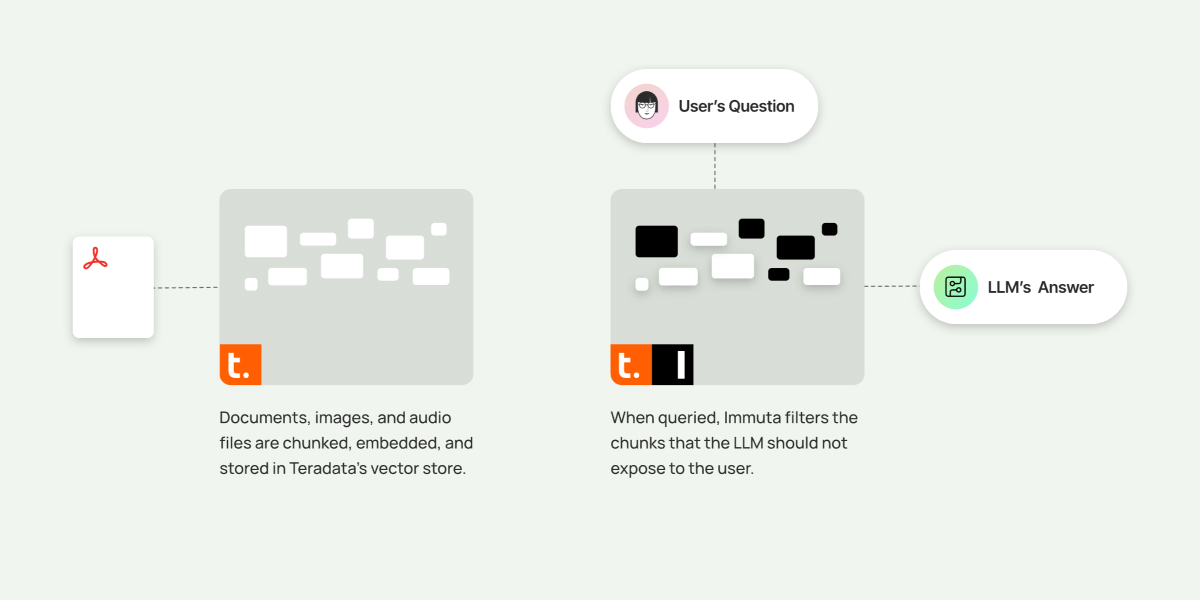
For example, an insurance provider may use RAG to support underwriting by asking questions over large collections of policy documents, claims guidelines, medical PDFs, and regulatory filings. Those documents may contain a mix of general guidance and sensitive information such as member details or internal risk models.
Immuta can classify and govern chunks of those PDFs at ingestion or retrieval time. When an underwriter or AI assistant queries the system, Immuta ensures that only the chunks they are authorized to see are retrieved from the vector store. Sensitive sections are filtered out before they ever reach the language model.
This allows organizations to bring their own large language models, build underwriting assistants, or deploy agentic workflows without creating a separate security model for AI. The same policies that govern analytics also govern what data AI systems can retrieve and reason over.
The result is AI built on trusted data, operating directly inside the Teradata ecosystem.
4. Unified audit and compliance across humans and AI
With more users, more workloads, and more AI in the environment, auditability becomes essential.
Immuta provides centralized auditing across all access to data in Teradata, capturing who accessed what data, when and where access occurred, which policies were enforced, why access was granted, and how data was used, including by AI and automated agents.
This unified audit trail spans traditional analytics, self-service provisioning, and AI-driven access. It simplifies regulatory compliance, internal governance, and ongoing access recertification.
For compliance teams, this reduces blind spots. For data leaders, it enables faster progress without fear of breaking policy.
The business outcomes: Modernization without disruption
Together, Immuta and Teradata deliver clear business outcomes for enterprises modernizing their data platforms.
Organizations gain confidence operating across Teradata on-premises and cloud environments with consistent governance. Data access accelerates without requiring data movement or duplication. AI initiatives scale with security and compliance built in from the start. Operational overhead for IT and data teams is reduced through automated, policy-driven workflows
Better together: Intelligent governance for what comes next
Teradata remains the foundation for enterprise intelligence that delivers trusted, autonomous action. Immuta enhances that foundation by embedding intelligent data governance directly into the platform as a core capability.
The result is a modern data environment where access is dynamic, AI is governed, and compliance keeps pace with innovation, all while preserving the performance, scale, and reliability Teradata customers depend on.
For organizations looking to bring their existing Teradata environments into the modern AI era, Immuta and Teradata are better together.
See it in action.
Discover how Immuta and Teradata work together to deliver policy-driven access, secure AI workloads, and audit-ready visibility.