Beyond the Prompt: Navigating the 3 Data Access Archetypes for Enterprise AI

Share on


As enterprises rush to deploy autonomous AI agents, a quiet realization is setting in across engineering teams: AI problems are ultimately data governance problems. We’ve spoken to many of the most security conscious customers on the planet about their AI platforms, and when we look under the hood of most enterprise AI deployments today, we see an architectural tug-of-war. Teams are struggling to connect unpredictable, non-deterministic language models to highly secure, deterministic enterprise data platforms like Snowflake, Databricks, or Google BigQuery.
How we manage that connection dictates whether an AI initiative scales into a massive business accelerator or grinds to a halt under the weight of security risk. To understand how to build this correctly, we first have to get in the right headspace regarding how an agent interacts with your infrastructure.
When an AI agent interacts with an enterprise ecosystem, its actions are split across two entirely different architectural layers: the Control Plane and the Data Plane.
The security and operational breaking point for most companies occurs right at the boundary where the Control Plane hands off instructions to the Data Plane. Depending on how organizations architect that handoff, they fall into one of three distinct access patterns.
To objectively evaluate these access patterns, we have to look through the lens of modern, machine-speed vulnerability windows. Anthropic recently published a foundational blueprint titled Zero Trust for AI Agents: A security framework for deploying autonomous AI agents in the enterprise.
The paper delivers a stark warning to the industry: perimeter defenses are dead because frontier AI models compress the timeline between vulnerability discovery and active exploit from months down to hours. Because autonomous agents have the unique capacity to independently interpret goals, select tools, and chain operations together, standard access controls are no longer enough.
Anthropic explicitly challenges every enterprise architecture with a single question: Does a security control make an attack impossible, or just tedious? Agentic attackers possess infinite patience and near-zero per-attempt financial cost; controls that rely on mere friction (like complex prompt instructions or application rate-limiting) will inevitably degrade and fail. True security demands hard barriers at the infrastructure and data layers—completely removing an agent’s technical capability to do harm rather than simply throttling it.
With this framework as our baseline, let’s analyze the three data access archetypes dominating corporate deployments today.
The AI application connects to the underlying data platform using a static corporate service credential (e.g., AI_APP_PROD). In slightly more mature variations, organizations deploy a pool of several distinct service accounts divided by department or function (e.g., AI_FINANCE_READ, AI_HR_DEFAULT). The application’s Control Plane evaluates the user’s prompt and programmatically selects which service account from the pool is “most appropriate” to pass down to the database.
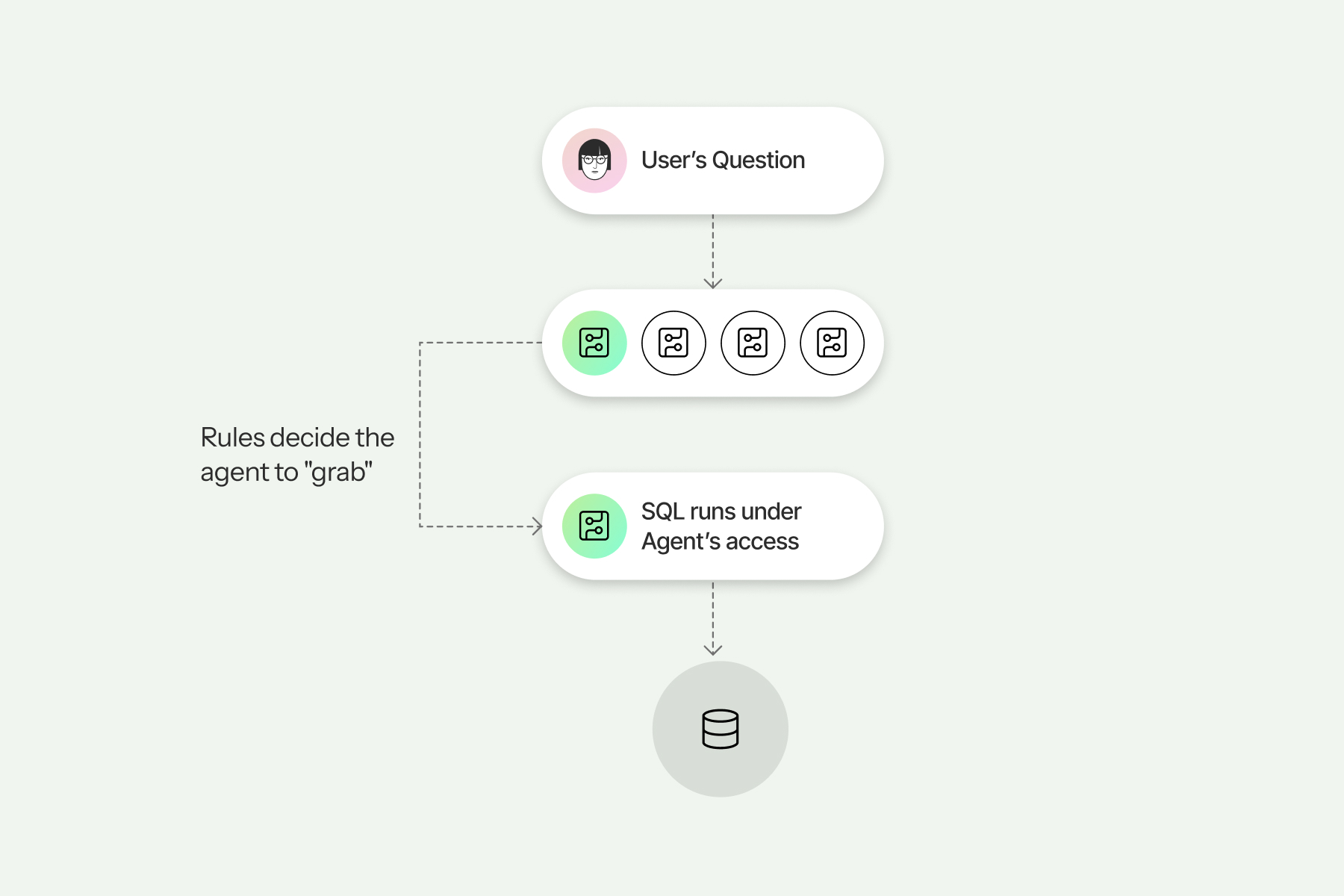
Severe Violation. Even with multiple service accounts, this model falls directly into what the Anthropic paper calls the Attribution Gap. Relying on the application’s control plane to choose the “right” account is a friction-based boundary, not a hard barrier. If an agent is manipulated via indirect prompt injection, an attacker can trick the control plane into selecting a higher-privilege account from the pool. Because the database platform cannot verify the originating user’s identity or intent, it blindly executes the query, granting an unmitigated blast radius to the exploit.
The agent attempts to directly mimic the human worker. When a user logs in, the agent captures their specific identity credentials or standing OAuth token and passes it down to the database, running queries as that human.
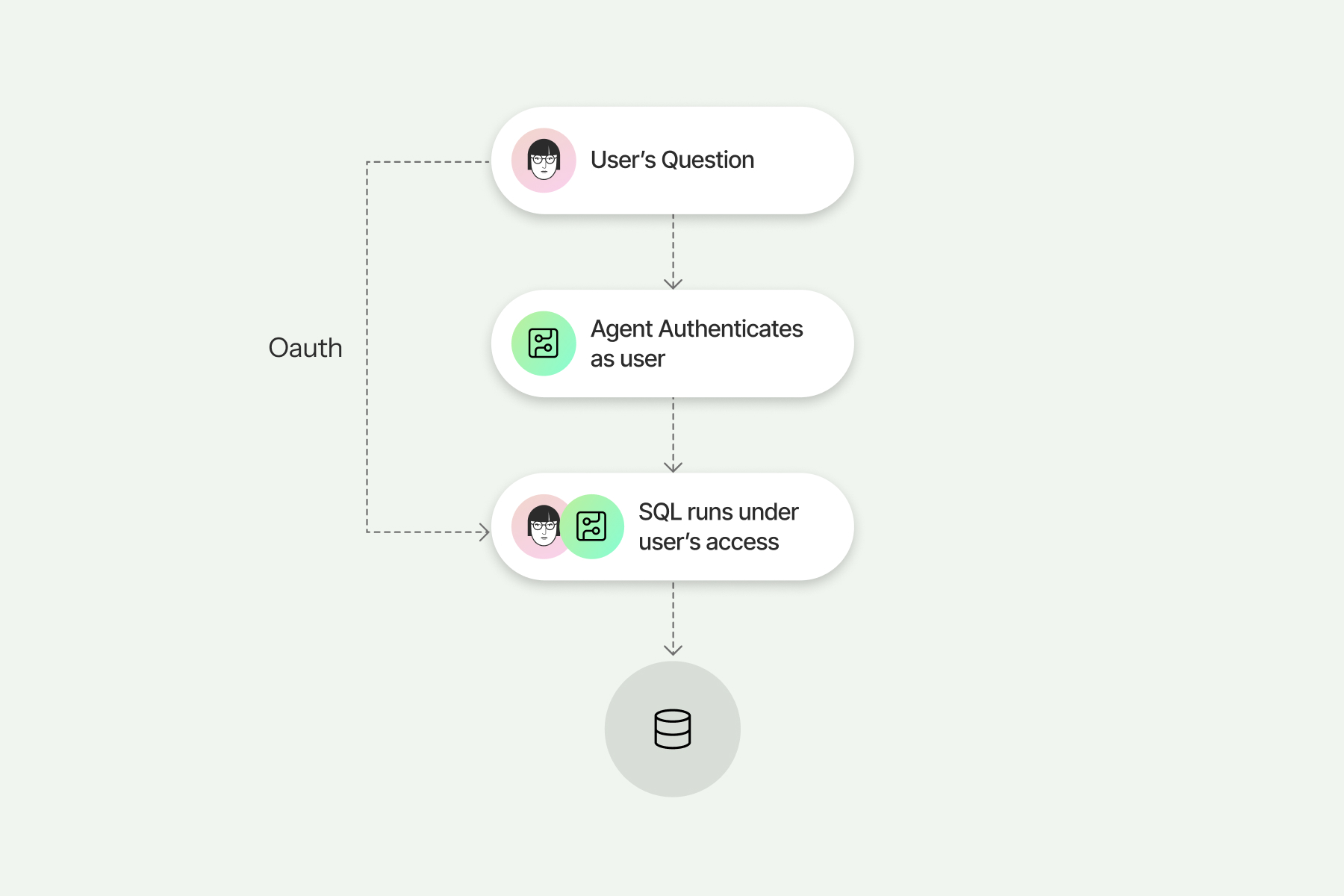
High Risk (The Confused Deputy). This archetype directly violates Anthropic’s core requirement for Least Agency—the principle that you must strictly constrain what an agent tool can do, how often, and where, independently of human permissions. If a human user has broad clearance, an impersonating agent inherits that full data power. This opens the door to a severe “Confused Deputy” vulnerability: an attacker can trick a low-privilege system (like an email-reading or web-scraping agent) into passing malicious instructions to a high-privilege agent. The high-privilege agent then blindly uses the human’s valid, inherited data access to execute a malicious data exfiltration.
Furthermore, from a pure cyber perspective, it requires that all human employees have an account and standing privileges in all your systems, just in case they might ask AI a question – creating a huge security vulnerability footprint.
This is the modern target state. Data access paths do not exist by default. The system introduces a separate, first-class identity for the AI system itself. When a query is initiated, the policy engine performs a Just-In-Time (JIT) identity union: it blends the distinct identity of the agent with the attribute context of the requesting human user. A temporary, task-bound database role is dynamically vended to support the request, and it automatically vanishes the moment the execution concludes. Moving forward, architectures can introduce an additional layer of functional intent over this configuration, refining the union into a tightly bounded identity intersection.
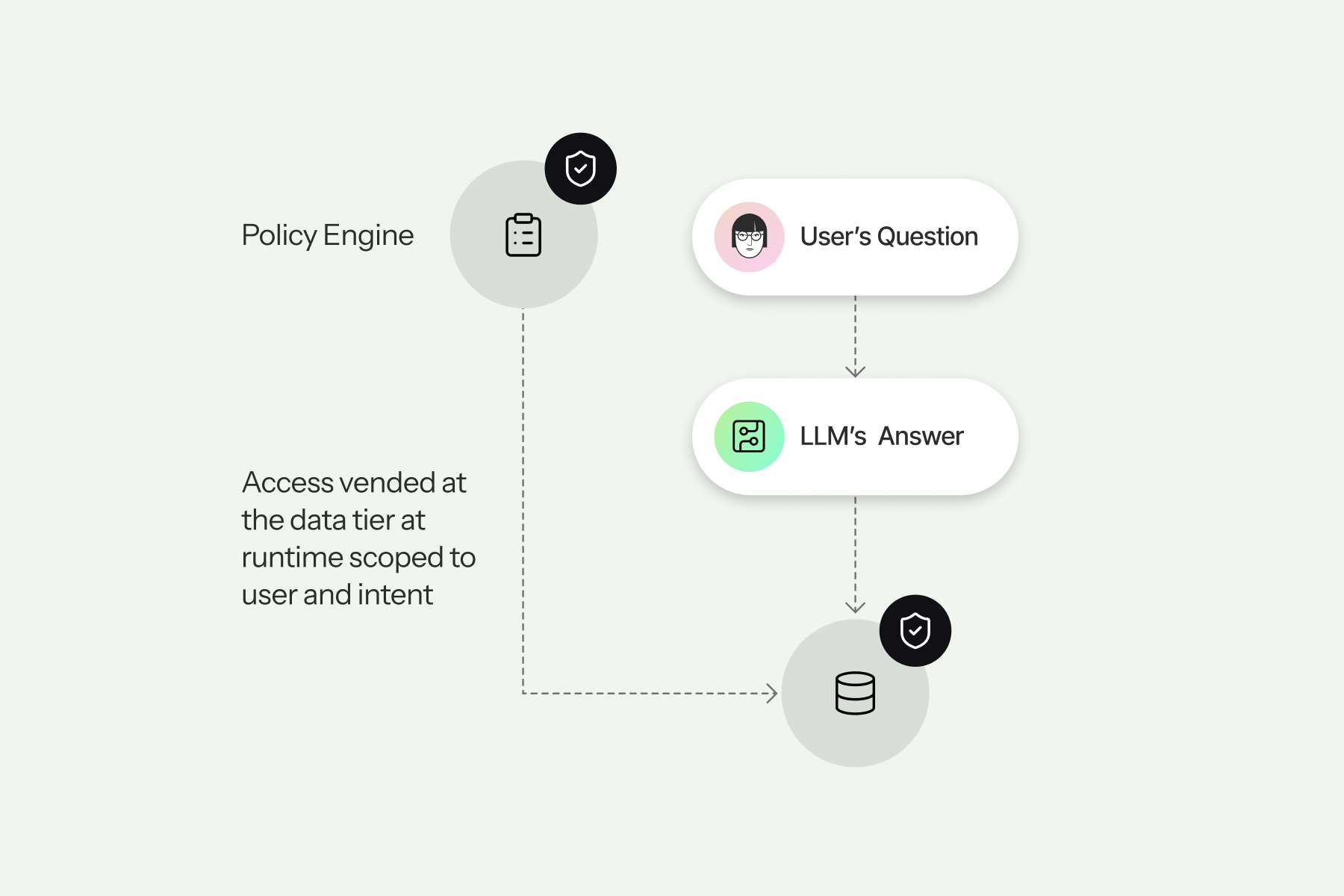
Perfect Alignment (The Advanced Standard). This archetype fully satisfies the framework’s baseline for advanced security. Registering the agent as a standalone, cryptographically verifiable identity completely eliminates the attribution gap. Furthermore, utilizing task-scoped, ephemeral tokens passes the “Impossible vs. Tedious” test. If an agent suffers from memory poisoning, there are no standing tokens or cached database privileges on the host environment for an attacker to harvest—the physical data access path simply ceases to exist.
When we evaluate these models against the reality of building enterprise software, Archetype C emerges as the definitive operational sweet spot because it represents the seamless marriage of the Control Plane and the Data Plane.
By combining these two layers, you unlock the best of both worlds:
When you combine a semantic engine with a data-plane access gateway, you get an extraordinarily elegant workflow. The agent uses Natoma to understand the relationships between financial tables (Control Plane). But when it goes to execute its Text-to-SQL query to pull the records, the data governance layer dynamically steps in, strips out PII, applies row filters based on the active human user, and authorizes the transaction via an ephemeral, task-bound token (Data Plane).
This approach transforms your security posture. You no longer have to build fragile prompt filters or write exhaustive application-level validation checks. Security shifts from a probabilistic guess inside an LLM prompt to a deterministic mathematical constraint inside your data platform.
Anthropic’s Zero Trust guide leaves us with a stark, accurate conclusion:
“The organizations best positioned for this shift will not necessarily be the ones with the most advanced AI. They will be the ones whose fundamentals are strong enough that AI-assisted scanning finds fewer bugs in the first place, and whose agent deployments were architected for breach from day one.”
If your AI architecture treats data access as an afterthought—relying on a single massive service account or blindly impersonating users without tool-centric boundaries—you are exposing your enterprise data estate to severe risk.
This architectural reality is precisely why Immuta is fundamentally focused on driving Archetype C architectures. We believe that for AI agents to achieve true operational utility, they must be treated as top-level identities bound by zero standing privileges, session-scoped context, and strict dual-identity auditing. By decoupling authorization from the prompt layer and enforcing it natively at the data plane, we turn the dangerous vulnerability of agentic manipulation into a secure, predictable, and compliant enterprise asset.