From Data Security to Data Provisioning: How Immuta Is Powering the Era of AI Data Consumers

Share on



For years, Immuta has been known as the data security platform — the place where organizations implement fine-grained access controls, automate governance, and enforce policies across complex data ecosystems.
That’s where we started, and it’s still foundational. But the world of data has changed dramatically. The next great challenge isn’t just about securing data. It’s about provisioning it — safely, intelligently, and at scale.
We’re entering a new era: one defined by data consumers, AI agents, and an unprecedented expansion of who — and what — needs access to data.
And that shift is fundamentally redefining what Immuta is.
In the early years of the modern data stack, organizations were racing to migrate workloads to the cloud. Snowflake, Databricks, BigQuery, Redshift — everyone was investing in best-of-breed platforms. But as this cloud diversity expanded, a clear problem emerged:
There was no unified way to manage access and policy across them.
That’s where Immuta came in. We built a platform that separated policy from platform, enabling teams to define consistent access controls — ABAC, RBAC, and purpose-based rules — that could be applied across any cloud environment. It was a foundational innovation that allowed data teams to secure data without sacrificing usability.
For years, this was the frontier of data governance. But while the data platforms evolved, so did the people — and the tools — accessing them.
Back in 2018, Immuta’s primary users were data engineers and scientists — people who lived in code, worked in SQL and Python, and used notebooks, and who understood schema, lineage, and policy.
Fast forward to today, and something extraordinary has happened: AI has democratized access to data.
Through the rise of agentic AI, every person in an enterprise — from marketing and financial analysts to supply-chain managers and compliance officers — can now interact with data directly.
They’re not writing queries.
They’re not managing schemas.
They’re using AI-powered tools that abstract all of that complexity away.
Behind the scenes, these tools are connecting to the same databases, warehouses, and storage systems engineers have always used. But to the end user, it’s seamless — the data just appears.
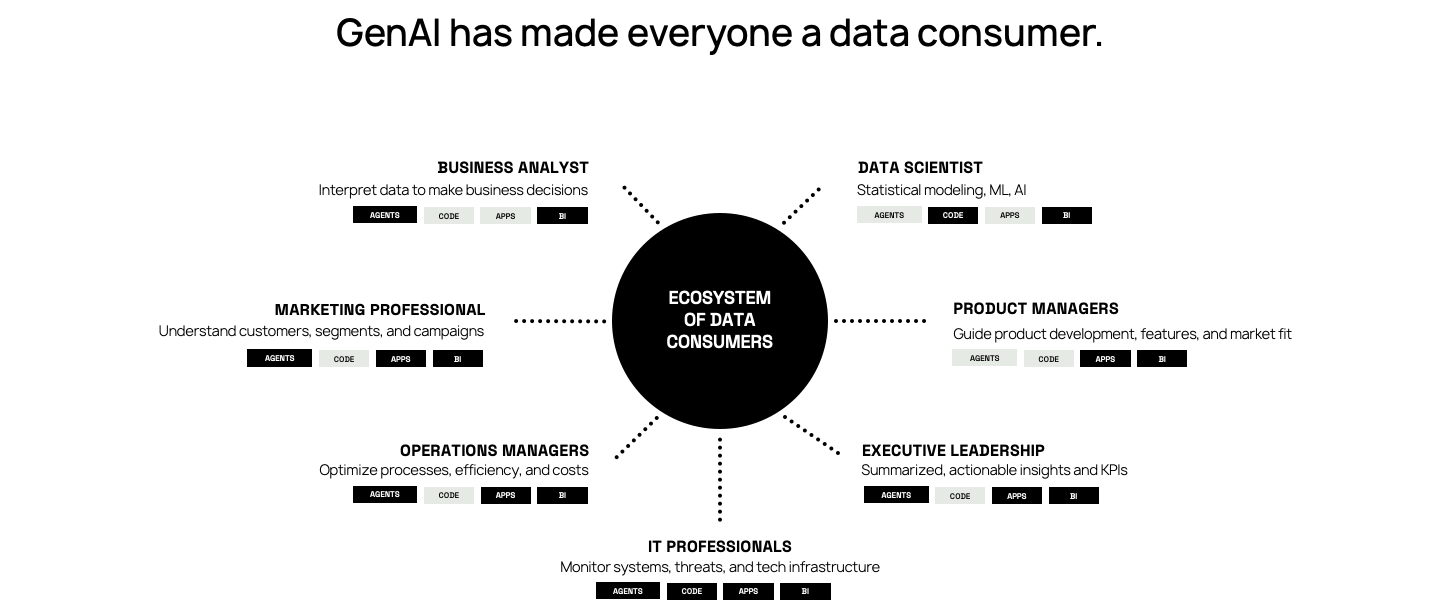
This is what we call the Era of Data Consumers. And it’s the foundation for the next generation of intelligent enterprises.
This explosion of data consumers — and soon, AI agents — creates a massive new challenge for governance and security teams.
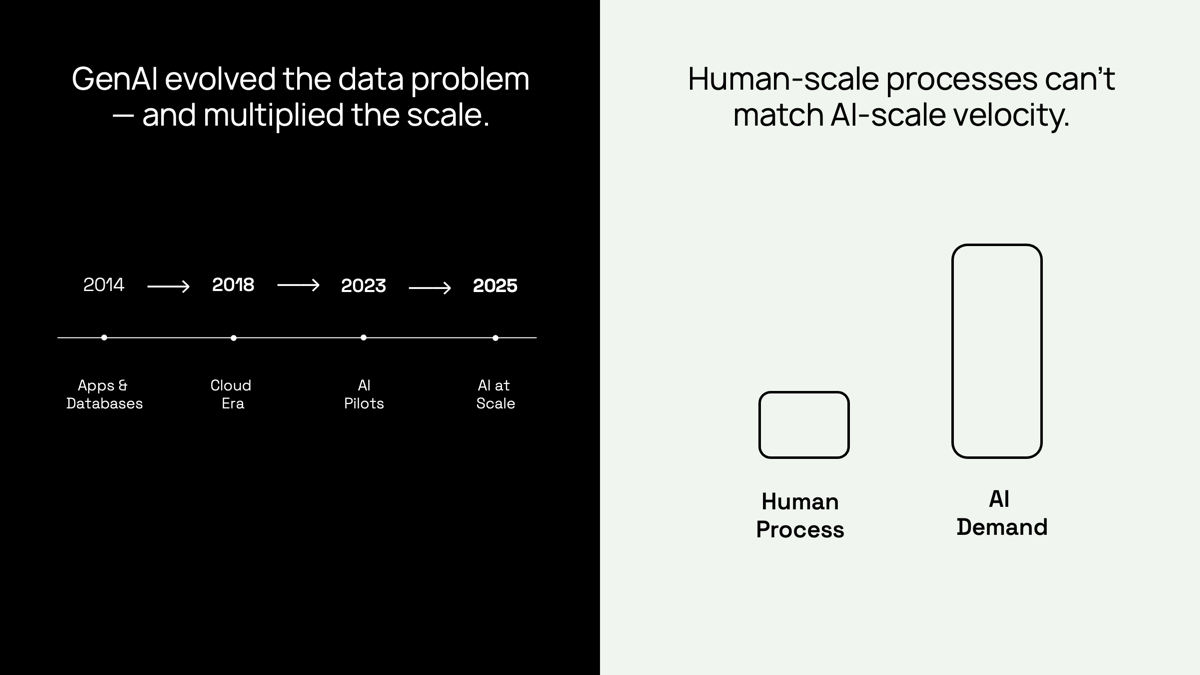
Traditional data security models rely on predefined policies — static rules that specify who can access what data and under which conditions. But as the number of data consumers grows, and as AI-driven requests become more dynamic, those policies simply can’t keep up.
Here’s the reality inside large enterprises today:
This isn’t a technology failure. It’s an architectural one. We’ve built secure data systems that are too rigid to adapt to the dynamic, agentic world emerging around them.

What enterprises now face is a new kind of bottleneck — a data-access debt problem. And the only way out is to evolve from static security to intelligent provisioning.
A data provisioning company doesn’t just secure data; it delivers it responsibly, at the speed and scale required by modern enterprises and their AI systems.
At Immuta, that means moving from a security control plane to a provisioning brain — one that governs who, what, when, why, and how data is accessed across every system.
We think of this as provisioning by policy and by request.
The first layer of data provisioning is what we’ve always done best — defining and enforcing access controls automatically across platforms. These birthright access policies give consistent, immediate access to approved datasets without friction.
The new world requires something more flexible: the ability to handle on-demand access requests that can’t be anticipated by static rules.
In this model:
The result is a provisioning model that meets data consumers where they work — allowing them to request and access data responsibly, without friction, while giving governance teams visibility and control.
Provisioning at scale isn’t just about automation — it’s about collaboration between humans and intelligent systems.
To handle the sheer volume and diversity of requests, organizations will need what we call governance intelligence — the combination of AI, policy logic, and human expertise that enables adaptive decision-making.
Here’s what that looks like in practice:
Together, these components form a closed-loop provisioning system — one that continuously learns from decisions, reduces human toil, and improves governance outcomes over time.
As generative AI matures, the next logical evolution is agentic governance — the ability to govern not just humans, but autonomous agents acting on their behalf. These agents will be everywhere: automating reporting, generating insights, preparing board decks, writing compliance reports, even optimizing supply chains.
But they won’t succeed if they’re blind to the rules of data. Agents can’t simply inherit their creator’s access rights. They need purpose-based authorization — access that aligns with what they’re doing, not just who they represent.
That’s where Immuta comes in.
Immuta’s provisioning logic — with its deep policy engine, risk-based evaluation, and unified audit trail — becomes the foundation for this agentic layer. It allows enterprises to:
In short: we’re building the infrastructure that will let enterprises scale AI safely.
As enterprises expand from a few thousand engineers to millions of data consumers and agents, they’ll need a single, intelligent layer that governs data access coherently across all systems.
That’s the vision of Immuta as a data provisioning company — a platform that:
This isn’t about replacing data security — it’s about transcending it.
Security remains the foundation, but provisioning is the engine that makes data usable and valuable.
Enterprises are standing on the edge of an AI-driven transformation. The winners won’t just be the ones with the most data — they’ll be the ones who can provision data responsibly, intelligently, and at scale.
Immuta is building for that future.
We’re expanding our remit from data security to data provisioning — because the era of agentic AI demands it.
The enterprise of tomorrow will have millions of agents interacting with data every second. Our mission is to make sure every one of those interactions is secure, compliant, explainable, and fast.
That’s what it means to be a data provisioning company. And that’s the next chapter for Immuta.