Immuta Joins the American AI Data Stack Consortium: Why Sovereign AI Runs on Authorization

Share on


This week the U.S. Department of Commerce designated the American AI Data Stack Consortium (AADC), anchored by Snowflake, as a priority full-stack AI export package. Immuta is proud to be a member, alongside NVIDIA, OpenAI, Reflection AI, Palo Alto Networks, Ericsson, and SailPoint.
The designation comes in the first round of the American SI Exports Program, launched under Executive Order 14320 as the American AI Exports Program and run by Commerce’s International Trade Administration. Commerce designated 33 consortia, led by 19 anchor companies, whose packages U.S. government representatives can bring to trusted partner nations. Designated packages can qualify for government-to-government advocacy, prioritized export license review, and financing referrals.
Each consortium covers the full stack, from compute to applications. In ours, NVIDIA and Ericsson bring compute and networking, OpenAI and Reflection AI bring models, and Palo Alto Networks and SailPoint bring cybersecurity and identity governance. Immuta sits in the data layer with Snowflake.
Snowflake put the consortium’s thesis plainly in its announcement: “SI is only as trustworthy as the data it can securely reach.” Immuta’s job is the second half of that sentence. We decide, at the moment of access, which people and which AI agents can reach which data, for what purpose, and we keep the proof.
Partner nations want American AI, and they need to keep control of their own data. Those two goals meet at a single point: the moment a person, a model, or an agent asks to use a piece of data.
Data residency settles where data lives. It doesn’t settle who can use it, for what purpose, or under which law. A health ministry, a central bank, or a defense agency needs those answers enforced on every query, with a record its auditors and regulators can check.
That is the work of authorization. A nation writes policy in the terms of its own rules, such as classification, citizenship, consent, and purpose, and that policy is enforced the same way wherever the data sits. Sovereignty stops being a clause in a contract and becomes a control the buyer defines, tests, and audits.
Why sovereign AI runs on authorization, in 83 seconds.
Each layer of the stack answers a different question. SailPoint governs identity: who a person or agent is, and what they are entitled to. Snowflake provides the governed data foundation, and Palo Alto Networks secures the networks and workloads around it.
Immuta answers the question in between: may this request, from this identity, touch this data, for this purpose, right now? We evaluate each request against policy in real time, enforce the answer natively in the data platform by masking a column, filtering rows, or denying access, and record the decision.
Identity and authorization reinforce each other. Identity establishes who is asking and what they are entitled to. Authorization combines that with the sensitivity of the data and the purpose of the request to decide each query, which is the level of control a sovereign buyer will expect.
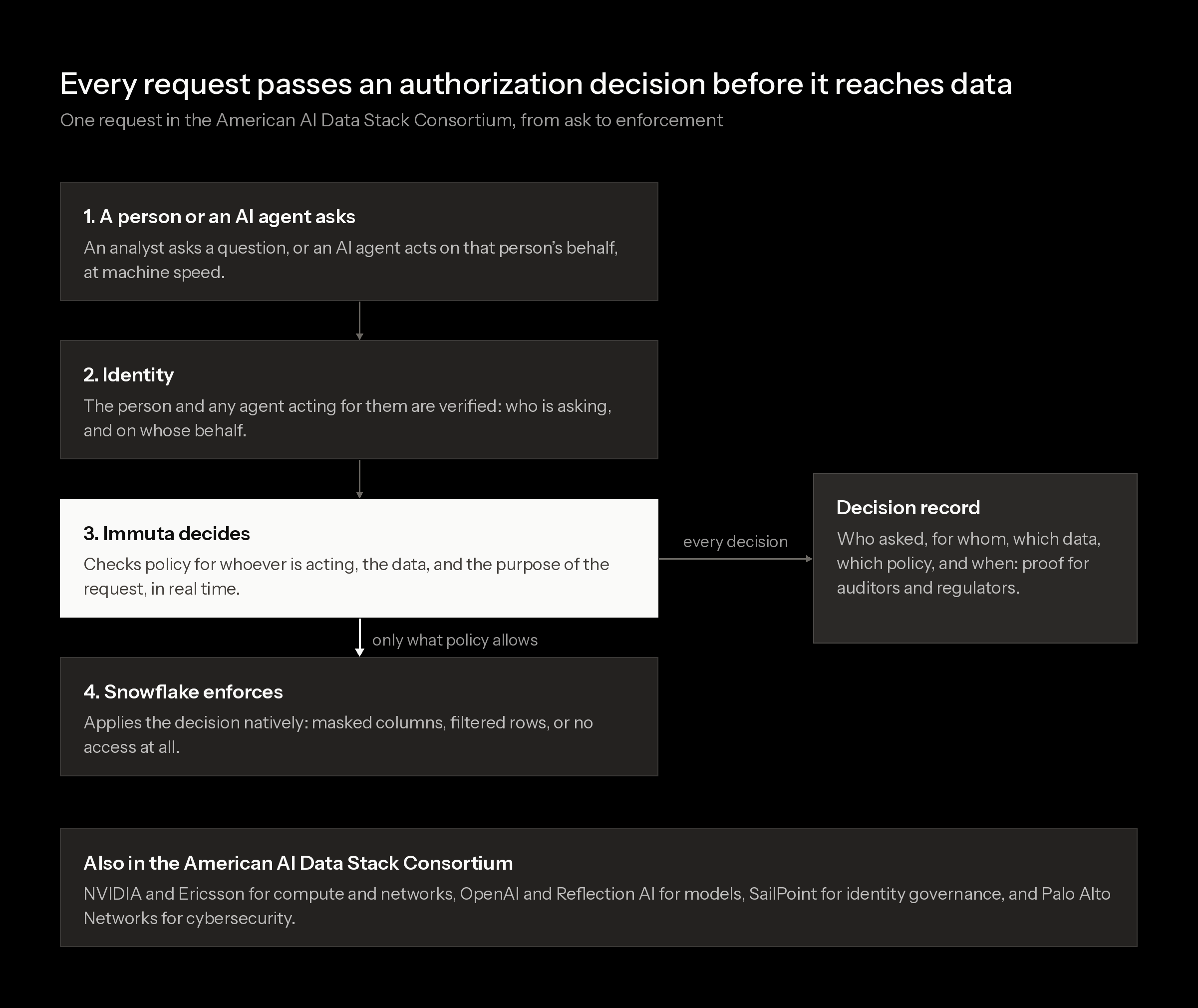
AI agents change the math of access. An analyst might run a few dozen queries in a day. An agent working on that analyst’s behalf can run far more, across more systems, at machine speed.
Access models built on static roles and manual approvals were designed for people. Applied to agents, they either stall the work or grant far more access than the task needs. Neither is acceptable for a nation’s most sensitive data.
Authorization for agents has to be dynamic, scoped to the task, and bounded by the authority of the person the agent works for. That is what Immuta is built to do, for humans and agents alike.
We founded Immuta after years in the U.S. intelligence community, where sharing sensitive data and protecting it were the same job. Today some of the world’s largest banks, pharmaceutical companies, and public sector organizations rely on Immuta to authorize access to their most sensitive data. We have enforced policy natively in Snowflake for years, so partner nations get an authorization layer that is already proven in production.
We’re grateful to the Department of Commerce and the International Trade Administration for this designation, and to Snowflake for anchoring the consortium. In the months ahead we’ll work with our AADC partners to bring this stack to partner nations, where government, defense, financial services, and healthcare have the most to gain and the most to protect.
Nations won’t choose an AI stack on model benchmarks alone. They’ll choose the one they can trust with their most important data, and verify that trust on every request. That is the stack we intend to help America export.
If you’re leading a sovereign or public sector AI program, we’d like to hear from you. Talk to our team.
What is the American AI Data Stack Consortium?
It is a group of technology companies, anchored by Snowflake, that the U.S. Department of Commerce designated as a priority full-stack AI export package. Its members are Snowflake, NVIDIA, OpenAI, Reflection AI, Palo Alto Networks, Ericsson, SailPoint, and Immuta, and together they cover the stack from compute to applications.
What is the American SI Exports Program?
It is a Department of Commerce program, run by the International Trade Administration, that designates full-stack AI packages U.S. government representatives can bring to trusted partner nations. It was launched under Executive Order 14320 as the American AI Exports Program. Designated packages can qualify for government-to-government advocacy, prioritized export license review, and financing referrals.
What does Immuta do in the consortium?
Immuta provides data authorization in the data layer, alongside Snowflake. For every request from a person or an AI agent, Immuta decides what data it can use and for what purpose, the data platform enforces that decision natively, and every decision is recorded for auditors and regulators.
Why does sovereign AI need data authorization?
Data residency controls where data lives, not who can use it, for what purpose, or under which law. Authorization enforces a nation’s own rules on every query, wherever the data sits, and keeps a record its regulators can check.