Immuta Extends Its Authorization Layer Into Teradata AI Studio for Agentic Data Access

Share on


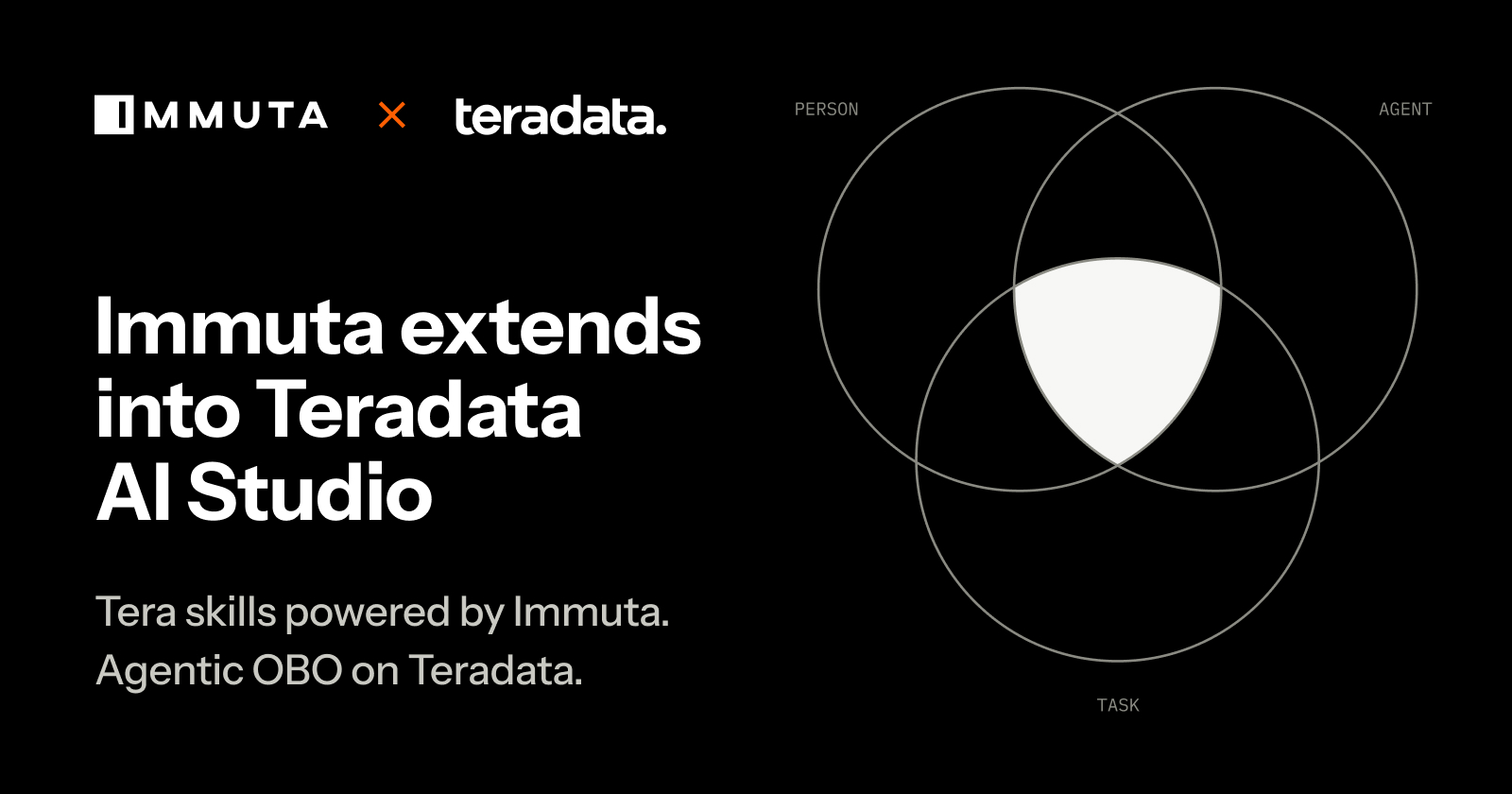
AI agents are moving from pilots into the daily operations of the enterprise, and more of them are being built where the data already lives. For Teradata customers, that place is increasingly Teradata AI Studio, where Tera, Teradata’s agentic coworker, works directly against governed enterprise data.
That shift makes one question more important than any other: what should an agent be allowed to do with the data, and on whose behalf? Answering it is the job of data authorization, and it is why Immuta is deliberately building a deeper integration with Teradata AI Studio.
In February, we added attribute-based access control (ABAC) to Teradata, enforced natively at the row and column level. Today we’re building on that foundation in two ways. First, we are extending Immuta into Teradata AI Studio with three Tera skills: one to author policies, one to handle data request workflows and one to prove compliance through Comply. Second, we are adding Agentic OBO support to Teradata, so agents are treated as first-class identities and we can begin to control what agents do on Teradata.
Teradata AI Studio is built on a principle we share: data stays in Teradata. Queries run where the data lives, under the platform’s access controls. That makes those controls the most important part of any agent architecture. If they are static, role-based and designed only for humans, every agent either inherits too much access or gets too little to be useful.
As our CTO, Steve Touw, described in Beyond the Prompt, most enterprise agent deployments today fall into one of two risky patterns: shared service accounts that erase the identity of the person asking, or impersonation that hands an agent every standing privilege its user holds. The target state is different: a first-class agent identity, combined just in time with the context of the person it serves, with zero standing privileges. Our work with Teradata is about making that target state the default in Teradata AI Studio.
Tera skills powered by Immuta
Tera picks up new capabilities through skills. We are adding Immuta’s functionality to three of them, so the people responsible for data can do their part without ever leaving Teradata AI Studio
Agentic OBO on Teradata
Agentic OBO support makes agents first-class identities on Teradata. Today, most agents reach data through a shared service account or by borrowing a person’s login, so the database can’t tell an agent apart from anyone else. With Agentic OBO, short for on-behalf-of, each agent has its own identity, and every request it makes is decided on behalf of a specific person: what that person is entitled to, what the agent is permitted to do and what the task requires.
That is how we begin to control agents on Teradata. Access is granted just in time, covers only what all three allow and disappears when the work is done. Every query is attributable to both the agent and the person it served, and there are no standing privileges for an attacker to harvest.
The integration follows the same separation Steve outlined between the control plane and the data plane. Tera plans the work and asks for access in Teradata AI Studio. Immuta makes the authorization decision. Teradata enforces it natively in the data plane, so the data never passes through Immuta and nothing is copied.
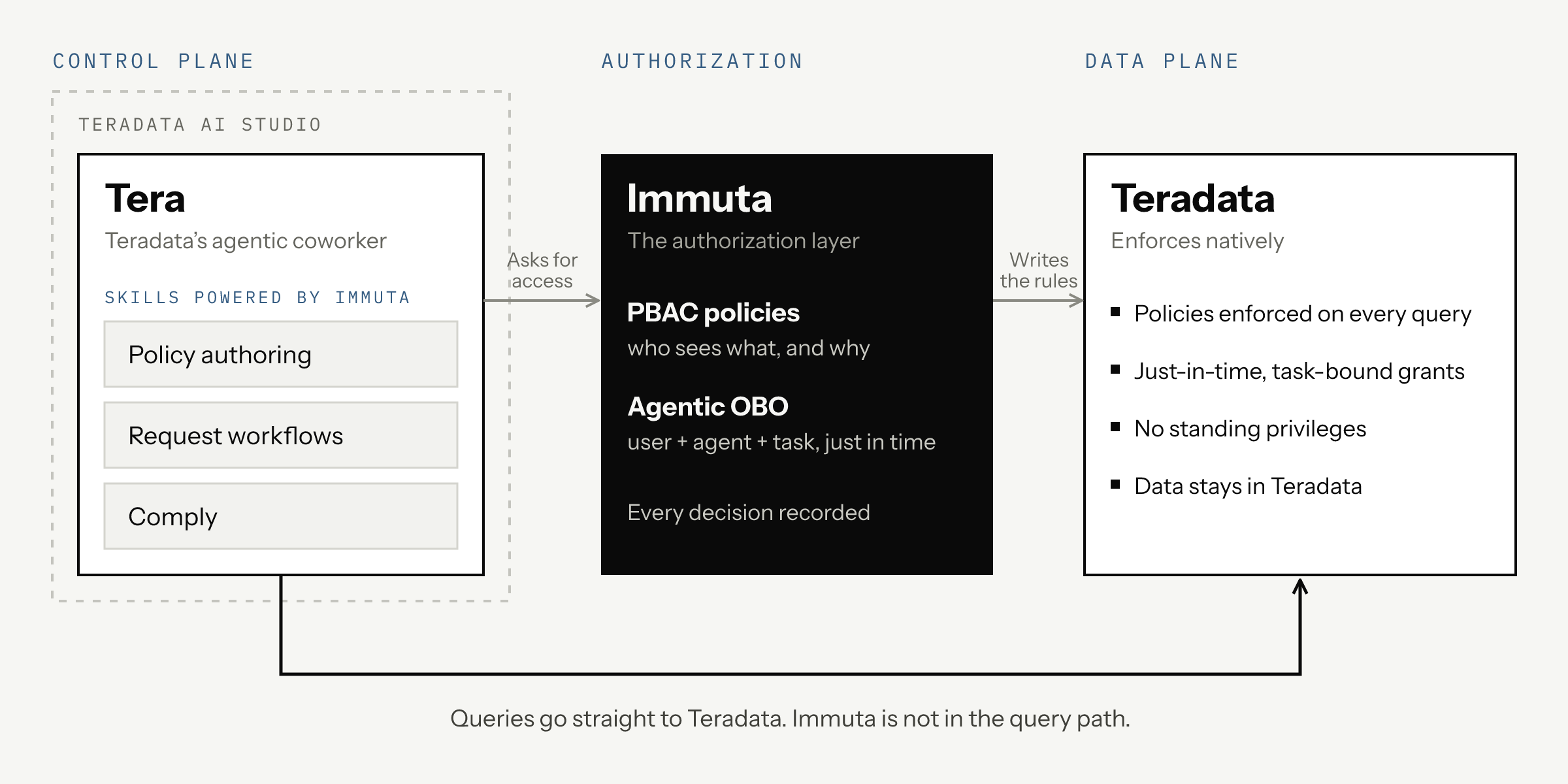
Because policies are enforced inside Teradata, they apply consistently to every person and every agent, in the cloud and on premises.
In our demo, an analyst asks Tera which merchant categories have the highest fraud rate. Tera discovers she doesn’t have access, files the request in the chat, and policy approves it automatically for one hour. The answer comes back from Teradata with customer details masked. When she needs names to notify affected customers, a reviewer grants a one-hour exception that expires on its own. Two governed decisions, and no tickets.
Immuta’s Teradata integration is available in public preview today, with subscription policies, row filtering and NULL column masking on Teradata views, in the cloud and on premises. The Tera skills and Agentic OBO support described here extend it into Teradata AI Studio and to the agents running on Teradata. See the Teradata integration, or talk to us about bringing it to your environment.
Agents are only as trustworthy as the access they are given. By extending Immuta’s authorization layer into Teradata AI Studio and making agents first-class identities on Teradata, we are making sure every question is authorized, every query is controlled and every agent is accountable, wherever Teradata customers put agents to work.